
Customer Reviews With Photos
A good LiFePo4 charger. They are best charged to 14.4-14.6V, then stop or float at 13.6-13.7v. I couldn't confirm that this does the float voltage but the LED sticker suggests it does. I only use lithium batteries for power in my ham radio station and my camper. This is a good charger to have!

This is the perfect maintainer for my RV battery. I tested it out and it is super easy to set up. I stuck it in the window of the RV cabin and plugged it into the lighter outlet. Bam! It keeps the battery topped off and ready to go. Really happy I made this purchase. Very happy! It also comes with several cords so it can be used directly to battery with clamps, to the lighter and even eyelets to use for other types of connections. Great product!

On the bench today, I’ve got a Kimbluth 10 AWG Solar Extension Cable 10FT, Flexible Solar Panel Wire with Male to Female Connector Parallel Tinned Copper Wire for Solar Panel, Automotive, RV, Boat, Outdoors. The connectors and the wire are both good enough. The connectors fit firmly to the multiple brands/types I have near the bench and I’ve come across this exact connector before. No problems there. The crimps seem adequate as I couldn’t pull any of them loose. The wire is a fine, basic wire. I’ve handled this exact wire before on other products and know it’s pure copper. I don’t think I’d expect it to have any special UV resistance tho. It’s not even remotely comparable to my actual solar cables with their thicker, dual jackets and their UV resistance. I personally wouldn’t expect this wire to last if left outdoors with sun exposure full time and think the listing claim specifically pointing out UV resistance is a bit of a stretch. Tho with a wire this short, it would likely be used more in short term roles like camping or occasional usage and it would work well to fill that role. Overall, the wire and connectors are pretty good quality products and I’d have no issue using it in short term applications or ones where it doesn’t have permanent sun exposure. It could probably excel as panel extensions for larger arrays where the panels would keep it shaded. It would need to be cheaper for me to choose it over other high quality brands I’m already familiar with tho.

I had been buying, using, and recommending power stations for over 6 years now, including those from Goal Zero, Jackery, Bluetti, EcoFlow, and many other brands. EcoFlow really surprised me with their Delta Pro that I bought a few years ago for our vacation home due to many of its innovative features. In fact, a Goal Zero representative I spoke with at a conference was surprised by EcoFlow's engineering chops that year. It put the company on my radar as one of the top power station manufacturers I could recommend. Thus far, I had bought, tested, and compared EF's Delta Pro and Delta series batteries, and I was curious about what the River line was targeting. Jackery and Goal Zero did not distinguish their products much: Jackery has the Explorer/Explorer Pro, and Goal Zero the Yeti X/Yeti Pro. What I learned was that River offered lower-capacity batteries (up to 286Wh or 858Wh with expansions) for portability and low-powered devices like laptops and cameras. Delta was designed for larger appliances and tools, for extended runtime (with battery capacity between 1,000Wh and 12,000Wh), or even to power a home or RV. If you do not know what "Wh" (Watt-Hours) and "W" (Watts) mean, do not worry. I will go over the basics later on in this review. For now, know that Watt-hours measures the battery capacity -- how long something can run for -- and Watts measures how much power is used or produced. When shopping for batteries, you will also run into terms like "Lithium-ion" and "LiFePO4". In fact, many people are confused about what they are. We will go over them in more detail later, but know that EcoFlow's batteries all use LiFePO4 now (as do Bluetti's). Jackery and Goal Zero only recently switched to LiFePO4. This battery chemistry's greatest benefit is longevity: lasting at least 10 years with normal use. ANALYSIS The EcoFlow River 3 Plus (or "Max') is a compact, portable battery designed for everyday use with lower-powered devices like cameras, phones, laptops, car freezers, and home network equipment that keeps the internet running. Where EcoFlow shines compared to competitors is its embrace of modular designs. The River 3 Plus (286Wh capacity) can be expanded with an extra battery that doubles (572Wh) or even triples (858Wh) its capacity, depending on which Smart Extra battery you pair with. With 572Wh, a car freezer could run for a full day, and with 858Wh the same appliance can run between 1.5-2 days, depending on how warm the ambient temperature is. In cold weather, the car fridges can last even longer. River 3's naming convention is a bit odd: the base, River 3 Plus (286Wh), becomes River 3 Max (572Wh) by adding the Smart Extra Battery EB300 (286Wh), and turns into River 3 Max Plus (858Wh) by adding the Smart Extra Battery EB600 (572Wh). In other words, all 3 "models" share the River 3 Plus as their base. Sweet Spot: The 1,000Wh battery capacity hits the sweet spot for many consumers, including this author, who are looking for the right balance of power and portability. But when it comes to home integration, the more Watt-hours a battery ecosystem offers, the longer one can power a home for during a blackout. The River 3's advantage with the lower capacity (286Wh, 572Wh, or 858Wh) is portability where space may be at a premium. Plus, they are far lighter to carry than 1,000Wh or larger batteries. EcoFlow, Goal Zero, Jackery, and Bluetti power stations can be used while simultaneously charging themselves. WHICH MODEL IS BEST? Which power station to get depends on your needs, and for that, I recommend you read the "CONTINUOUS VS PEAK OUTPUT" section of this review, then check the "CALCULATIONS" part to figure out what size battery to get. BATTERY TECHNOLOGY As I previously stated, the River 3 uses LiFePO4 (Lithium Iron Phosphate) whereas older Jackery and Goal Zero batteries used Nickel Manganese Cobalt (NMC). The latter is also used by today's cellphones from the likes of Apple and Samsung. Where individuals are often confused is that some consider LiFePO4 to be better than Lithium-ion (Li-ion) batteries, but in reality, both NMC and LiFePO4 are Li-ion. I found many incorrectly referring Li-ion to be NMC and not LiFePO4. Regardless, what are the differences between NMC and LiFePO4? LiFePO4 is bulkier and heavier than NMC, yet most power station vendors now use LiFePO4. Here is why LiFePO4 is better than NMC: - Safer, less volatile, and thus cheaper to manufacture - Charge cycle: 1500-2000 (10+ years) -- NMC: 20-25% capacity loss after every 500 cycle (6-10 years for up to 2000 cycles, after which capacity is vastly diminished) -- EcoFlow claims 3500 cycles before dropping to 80% of original capacity and 6500 to 50%. - Usable in more extreme temperatures (-4F/-20C to 176F/80C). NMC: only 140F/60C max - Holds 350-day charge. NMC: 300 LiFePO4 batteries are less volatile (safer), more usable in extreme temperatures, and have a higher charge cycle count (battery lifetime) than NMC. You can see from some of my pictures that the River 3 Plus (286Wh LiFePO4) is nearly the same size as the Goal Zero Yeti 500x (497Wh NMC). Again, LiFePO4 has many advantages, but it is heavier and bulkier than NMC batteries. The River 3 Max (572Wh) is vastly larger than the Yeti 500x and adds just 75Wh of capacity. CAUTION: Lithium-ion batteries do NOT like to remain discharged at 0% for prolonged periods of time. If you let your battery stay at 0% for too long, you may not be able to charge it again without specialized equipment. CONTINUOUS VS PEAK OUTPUT It is important to understand the difference between Watts and Watt-Hours. How much power is used or produced is measured in Watts, and how much energy a battery can store is calculated in Watt-Hours. See the "CALCULATIONS" section below for more details. - AC Inverter: Converts battery (DC) power into AC -- River 3 Plus provides 600W continuous output with a 1,200W peak - Peak/Surge (Starting): Nearly every device initially draws extra power to turn on. The highest amount it pulls is the Peak. As long as that number is below 1,200W, it can be STARTED. Examples… -- Turns on OK (PEAK under 1,200W): --- Freezer starts at 400W (peak), runs at 150W once on -- Will NOT turn on (PEAK over 2,700W): --- Home AC starts at 4,000W (peak), runs at 1,000W once on Most devices power on at a higher (Peak) wattage than when they are already on (Continuous). Therefore, if its peak exceeds the power station's max, it may not be able to start - Continuous Output (Running): Once devices are on, as long as they keep drawing less than 600W total, they will stay ON until the battery runs out -- CONTINUES running (under 600W) --- 100W TV + 60W laptop = 160W -- COULD STOP running (over 600W) --- Temporary overdrawing beyond 600W for a few seconds is okay. A quality BMS will protectively shut down the battery if the surge does not end after a while. Regularly going over for a prolonged time can ruin the battery in the long run --- 450W appliance (600W peak) + 100W laptop (120W peak) = 550W (less than 600W). This will run fine ---- Add a 100W TV (130W peak) = 650W. Probably will stay on for a short period ---- Add another 60W laptop = 710W (over 600W). Battery will definitely shut down CALCULATIONS The below calculations are rough ESTIMATES as conditions, battery quality, and age can vary. [SORRY: I had to shorten my original review by a LOT (including many calculations) so it could fit here on tugapower.net.] Time to Charge the River 3 Max (572Wh) - Calc: Hours to charge battery = Battery capacity (Wh) / Input Wattage -- As battery approaches 75% full, the input charge will increasingly be slowed down to prevent overcharging - AC Wall: 380W @ 90 mins [572 Wh / 380W] - 12V Car Charger -- 120W @ 4.8 hrs (at 10A, if car supports it) -- 220W @ 2.6 hrs (at 18A, if car supports it) Charge Time with Solar - Calc: Hours to charge battery = Battery capacity (Wh) / (Panel Wattage x [0.5 or 0.75]) -- In a perfect lab, solar panels charge at the listed wattage -- Expect to only receive 50-75% on a good, sunny day (ie. 75W – 113W for a 150W panel), depending on panel's age, component quality, and weather - 200W solar panel: as fast as 3.8 hours [572Wh / (200W x 0.75)] - Underproduction: If a panel is not making enough, adding extra ones can generate a higher, combined output - Overproduction: If the panels make more than the maximum the power station charge port can take, only the max will go through Watts Used/Produced by a Device - Calc: Watts used or produced by device = Voltage x Amperage - Vacuum with 120V @ 9.5A uses 1,140W - Solar panel with 12V @ 10A can produce up to 120W Ideal Battery Power Station Size - Calc: Battery capacity (Wh) = Watts used by device x Hours needed for / 0.85 -- 10-15% of power is lost during power conversion - 45W car fridge needed for 8 hours: Minimum 424Wh power station (45W x 8 / 0.85) OTHER TOPICS - Mobile app control via WiFi or Bluetooth - Near-instant auto-switching between AC and battery power -- Makes it suitable for use as a Standby Power Supply (SPS) during a blackout - Expansion options -- Battery capacity expansion to a total of 858Wh with the Smart Extra Battery 600 (+572Wh) or 572Wh with Smart Extra Battery 300 (+286Wh) -- Connectivity with solar panels - 5-year warranty - NOT quite waterproof at IP54: protected against dust intrusion and water splashing from any direction, but do not leave it out in the rain FINAL THOUGHTS EcoFlow thoroughly impressed us with their Delta Pro power station and quickly added the company to our list of recommended battery providers. Their newest Delta 2, now a LiFePO4 product, further surprised us with 1,200W rapid-charging that took the battery from 0 to 80% in a whopping 50 minutes! Had we not seen that in person, we would have dismissed it as a marketing gimmick, but we were proven wrong. The River 3 Plus has continued with its engineering chops with solid specifications and performance, especially with its modular design where one can decide how much capacity to add to the base River 3 Plus unit.

The material is high quality and appears waterproof. The design of the hold down straps could use better engineering. You lose some strap down points if you fold up the side flaps so it can run while covered. That's not good during a storm. I wish it had more adjustments as it fits my Generac 5500 a bit loose. It came with a small labeled storage bag too. I'm not sure why? This is a storage cover. Once you install the cover, what good is the bag? Take $2 off the price and keep that bag.

I purchased this solar controller earlier this year to expand the solar lighting system in my shed. It's been doing it's job just fine, but about a month ago the USB ports stopped working. Everything else worked but I'd gotten used to being able to charge my phone while in the shed. So I emailed the warranty department that's listed in the product description and within 24 hours they had figured out wasn't something I could fix and they had a new controller on it's way to me! I installed the replacement today and everything works again! Happy dance!

This backpack/carry bag is a perfect fit for a jackery 100w solar panel. Lots of pockets for all kind of extension cables and extra cords. Good build, zippers are water resistant, reflective strip on the front. Good protection for your panel.

I will highly recommend this product. The setup was fast and easy.
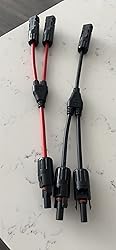
Decent build quality. I have several generator cables on hand for hooking up generators at several out buildings on my property. This cable is as good as other no-name brand cables, which are just about indistinguishable from the Champion generator cord I have.

I don't have a trail cam but I do a lot of hiking and camping and this solar panel is perfect for just that. It's lightweight but sturdy and durable. The glass panel feels solid and there is no flex or flimsy feel. The included adjustable mount makes it easy to put on a tree and to top it off, the body design has slots so you can run a strap through them and wrap it around a tree if you'd like. The battery is great and took me just an hour to charge my phone from 24% to 100. The included cables are a nice touch, and gives you a few 12V tips as well as USB-C Cables. Overall I felt like this was a great purchase. It has great functionality and value without breaking the bank.

I just love the ease with which it transfers, uninterrupted service, nice.

This portable, foldable solar panel feels really solid—nothing flimsy about it. The handles are sturdy, making it easy to move around, and the pull-out stand, though lightweight, holds the panel at a great angle for optimal sun exposure. When not in use, it secures neatly with velcro. The included charging cable is nice and long, giving flexibility when positioning the panel. I appreciate the multiple USB ports for directly charging smaller devices, plus the generous selection of adapters for various power banks. I tested it with both my small 160Wh power bank and a larger 1440Wh one, and it charged both effectively using the provided adapters. The little pouch attached to the backside of the panel is perfect for carrying the accessories, keeping everything together as a set. I don't know if I'd use it for backpacking (because of the size), but for camping or working at the beach, it's perfect. Overall, it’s a great backup energy source for emergencies or for when I’m on the go.

The first unit was DOA on the solar input. It never registered any voltage higher than the batter voltage and always showed "night mode" (that's a specific display of this model). The second unit did charge the battery but rapidly shifted between charge and discharge and the problem intensified with more sun. Pictures attached. I have never seen any charge controller seemingly randomly pull an extra 50W from a battery with PV attached and no load. Note the panel (a single 240w @ 30v IMP) was partially shaded by a porch post but it was a clear day and nothing other than the controller was the source of the issue. With the PV disconnected (via a breaker) all returned to normal with no charge or discharge. The idle draw is likely low enough where my Bluetooth BMS could not pick it up. Never had this issue with cheap PWMs or other high quality MPPTs (victron, midnite solar, EG4, etc). The second unit is being returned and my search for a cheap MPPT controller for adhoc projects continues.

The Callsun 50W Flexible Solar Panel is a game-changer for anyone needing portable, high-efficiency solar power on the go. Designed with mono crystalline PERC cells and a 23% efficiency rating, this panel delivers impressive energy output despite its compact size. The flexible, ultra-thin design makes it perfect for curved surfaces on RVs, boats, or camper vans, while the IP68 waterproof rating and ETFE material ensure durability against harsh weather, UV rays, and wear. I tested it with my Bluetti AC2A portable power station, and the pairing worked flawlessly the panel efficiently charged the unit even under partly cloudy conditions, proving its reliability for off-grid adventures. One of the standout features of this solar panel is its lightweight yet rugged construction. Weighing just under 4 lbs, it's easy to transport and install, whether mounted with adhesive or secured via the pre-drilled holes. The ETFE coating not only enhances light absorption but also resists scratches and yellowing over time, ensuring long-term performance. The included 10ft cables with MC4 connectors provided ample reach for my setup, and the panel's low-light performance was surprisingly good, maintaining a steady charge in suboptimal conditions. While 50W won't power an entire RV alone, it's ideal for maintaining batteries, running small appliances, or supplementing a larger solar array. Overall, the 50W flexible solar panel is a fantastic investment for campers, boaters, or homeowners seeking a compact, high-efficiency solar solution. Its compatibility with portable power stations makes it versatile for emergency backup or outdoor recreation. The balance of portability, durability, and efficiency sets it apart from rigid panels, and the sleek black design blends discreetly on any surface. If you need reliable solar power without the bulk, this panel delivers exceptional value just pair it with a quality charge controller for optimal performance.

I have a few inverters in my two homes. I picked up this inverter because I wanted a dedicated shop system. What I love about this system is that it has a combination standard 110v plug as well as a hardwired option as well in case you have a specific circuit that you want to power. I also like the fact that this system has a USBC output as many out there do not have USBC, just USBA. You can set the low voltage cutoff so you will never drop the battery below bad levels. I love that it is a safe solution right in the product. Setting it up was very easy to allow for different batteries as well as cutoff levels overall. Great mounting options as well! It comes with primary battery leads to the unit. Good value for the unit. I love it and would suggest it to others.
