
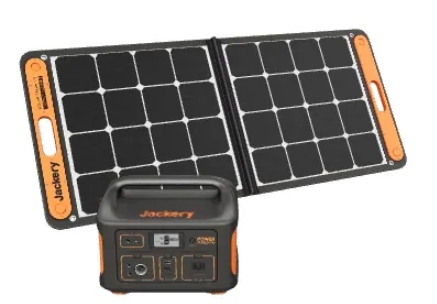
Customer Reviews With Photos
This wire is heavy duty and still reasonably flexible. If it is actually 100 feet long it will be perfect for my portable solar setup to get the panels out from under the trees.

Overall this is a nice cable and works great to allow me to get solar from my panels to my power stations in my garage. Thick gauge. My critiques are that the MC4 connectors used feel low quality and are difficult to disconnect. Most of the other MC4s I have, have tabs on the side to help release the locking tabs to make disconnecting easier. Also the male/female connectors are backwards and don't match up to my solar panels correctly based on the wire coloring. I had to use a multimeter to check this and confirm that they are in fact swapped. I will likely cut the connectors off and put on new MC4s so the polarity is correct.

The original 100 Watt solar panels have a lighter frame and are therefore lighter in weight than the heavier framed Renogy 100 Watt panels that look and perform virtually the same. I used four of the lighter weight DOKIO 100 Watt panels to construct two pairs of panels that are piano hinged on one side. I attached a cam action sash lock (to hold them closed) and a carrying handle on the other side. I sealed each of the screw locations with Loctite PL Marine Fast Cure Adhesive Sealant to prevent moisture entry. I positioned the solar panel sides to the inside of the hinge configuration to protect them during transport and carry. These two hinged assemblies when opened and wired together provide a nominal 400 Watt solar panel array. Note - the following information applies to DOKIO's original 100 Watt solar panels, not the 150 Watt panels described here on tugapower.net. Depending on your charge controller, you can wire the four 100 Watt panels in parallel (high 23 Amps/low 22.5 Volts) or in series (high 90 Volts/low 5.75 Amps). Another alternative (depending on your charge controller limits) would be to wire each pair in series (45 Volts/5.75 Amps) and then wire the pairs in parallel (45 Volts/11.5 Amps). The higher volts and lower amps can use smaller wires (10-12 Ga.) to efficiently (and safely) transport the power from the solar panel array to the charge controller if the charge controller is rated to handle more than 45 volts or 90 volts respectively. Update January 31, 2019 - At Ricky's request I added some pictures. Keep in mind that solar panel Wattage ratings are calculated under PERFECT conditions (the PANEL at 77 degrees Fahrenheit [not the air around it], 100% clean air and the panel perfectly aligned to the sun's rays). Virtually all solar panels will produce only about 70-80% of the panel's rated wattage in hot summer temperatures (-5% per 18 degree increase in the PANEL's temperature over 77 degrees). On the other hand, they can typically produce MORE power than the panel's rated wattage on very cold and bright sunshine days (+5% per 18 degree decrease in the PANEL's temperature below 77 degrees) so make sure your charge controller can handle the higher power if you plan to use these under very cold conditions. I discovered that I also need to work on controlling the RFI caused by the combination of my Chinese Manufactured MPPT charge controller and a 600 Watt Inverter ... RFI is not a good thing for operating Amateur radio equipment. Update March 23, 2019 - I have replaced my extremely RFI-Noisey Chinese Manufactured MPPT Charge Controller with a Morningstar PWM SunSaver Model SS-20L-12V that is compliant with FCC Part 15 rules regarding RFI control (made in Taiwan). Another Ham reported that this Morningstar PWM solar charge controller does not produce any RFI on his HAM system where he has connected his radio directly to the "Load" terminals on this model. Unlike most other solar charge controllers that allow only low-power lighting to be connected to their load terminals, this Morningstar charge controller's instructions describe full capacity loads (20 Amps in this case) can be connected to the charge controller's load terminals. This controller also includes a Low Voltage Disconnect (LVD) circuit that will shut the load terminals off if the battery's voltage drops enough to damage the battery if it is discharged any more. I will not operate my RFI-noisy DC-to-AC Inverter during Field Day. The FCC Part 15 rule compliant inverters cost in the neighborhood of $1,500-$2,000 and that high cost puts them beyond my budget. I haven't finished my portable power station for Field Day at this point but I will update this post after I get it operational and can determine if the charge controller produces any RFI on my Kenwood TS-2000 radio. Update June 27, 2019 - I updated my Field Day SLA AGM battery bank to a pair of Bioenno Power 12V, 20Ah Lithium Iron Phosphate (LiFePO4) Batteries and used only one of my 200 Watt panel arrays. The Morningstar Charge Controller mentioned above is designed to be used on Sealed Lead Acid (SLA), AGM or Flooded Lead Acid type batteries and does not work with Lithium batteries. To charge my new Lithium batteries I purchased a Genasun GV-10-Li-14.2V, 10.5 Amp 12 Volt MPPT Solar Charge Controller. I was concerned that its 10.5 Amp current limit might not handle the two DOKIO 100 Watt solar panels. However, in the 90 degree Fahrenheit heat (panels were hotter) and partly cloudy skies we had on Field Day this year, the panels (wired in parallel) averaged about 7 total Amps so no problem. I also used my older Kenwood TS-440SAT HF radio on Field Day and it worked very well. The Genasun Charge Controller (like the Morningstar) did not produce any RFI on the radio at all! We operated the TS-440SAT HF radio all day on Saturday on one battery and only changed over to the second battery around 9:00 PM and used that second battery Saturday evening until ~1:45 AM on Sunday morning when we shut down to get some sleep. We re-started at 7:30 AM Sunday morning and continued using the second 20aH Lithium battery until we shut down at the end of Field Day. The DOKIO solar panels did a good job on Saturday in spite of the 50% clouds (and a 20-minute rain shower). Sunday was mostly cloudy which limited the power from the two 100 Watt cells to about .12 Amps. Overall these solar panel's light weight and performance worked very well to build my small portable solar power system.
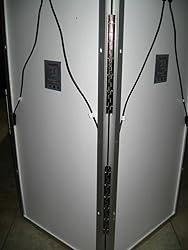
Es de calidad me gusta

This is a review for the DARAN Outdoor Generator Carrying Case for Portable Power Station, Travel Case for LiFePO4 Battery, Ideal for Emergency, Camping, and RVs, Size: 9.5 x 7.5 x 7.5 inches (Excluding Power Stations): This is a very well made bag designed for small solar backup generators. It is loaded with storage compartments for your cables and adapters. It does have a see through window on one side to see your power panel. However you cannot plug into anything while your unit is in the bag. It must be removed. The zippers work perfect and will allow you to open both ends and the top of the storage bag. With both ends open, my generator can intake air from one side and exhaust out the other end. Some other positive features are the heavy duty feet, a carrying handle and an adjustable shoulder strap. The bag value is good, however I can only give this review 4 stars. Why? Because with all the great features this bag has, it lacks a way to open the windowed front to be able to use your generator without removing it. It should have had a zippered opening to allow access to outlets. So close on this one. Overall this is a "Very Good" product that could have one improvement made to make it a great product. I still recommend it for the protection it does provide for your solar generator. Sellers photos are accurate and provide good details. Just make sure your generator is slightly less than the measurements provided to insure yours will fit.

I've only have it for under two months but so far it works great.

This is a nice solid set. My electrician installed it and he approved. It is a good rated wire and box.

Came quickly, professionally packaged.I purchased the 120wbaldr portable, it is well made, comes with cables that will help you connect to a variety of power stations/batteries. Will charge through USB straight from the control panel on back. I am using it to replenish ffpower station and no extra connections are needed outside the ones sent with panel, cables are strong but short. I'm not giving it 5 stars as at the highest is only producing low 70 watts, in the hottest sun and positioned perfectly with the sun. Sky is clear, sunny, no pollution. I will update if I can figure out a way to improve it. Suggestions are welcomed. I saw videos show much much better readings. UPDATE: I raised a star for the time and concern from customer service about only getting 70 watt they have offered to exchange or refund. Also tugapower.net has been very helpful. Normally I would send this back and find another panel. But at this time I don't have the convenience of going without backup power for medical refrigeration for a few weeks while this gets sorted out. Med Refrigerator only needs 45watts while condenser is running so 70 watts will top off battery if I am careful. I will save up for another panel when I can. The one thing not being said is Why rate this panel at 120 when it acts more like a 90 or 100 watt? The Elephant in the room.

I want to buy a new solar charge controller for my RV. I did some research on the internet and found this unit offered by a new company in Irvine on tugapower.net. It has the same specs as the Renogy Rover unit, but it costs $50 less. Installation was a breeze. There is an additional cable that connects to the temperature sensor, which is convenient. I took it for a 3-day trip in the desert. The unit is working well from day 1 and it seems to have good conversion efficiency (it claims 99%). It is worth the while to pay a bit more for a MPPT charger than a regular PV charger. This controller seems to work very well so far. I may buy another one for my backyard system. Good product!

I tested and find the battery to be a true at around 1280 the results are in my pictures and i wrote my findings down below. I want facts and not want to waste money or time which this product delivered. I fully charged the battery and tested it by running my A/C which took 2 hours and 18 minutes which consumed about 635 watts per hour at full blast. My inverter is 1500 watt inverter that is about 85% efficient; I tested my inverter before hand with other loads on other equipment. The end result was that the battery meter reads 1080 watts used so about 190ish watts was wasted from my inverter as heat/conversion process. I put 3 pictures of the test with one being max load being draw from my A/C, The A/C unit im using, with inverter, battery and watt reader, and also end result of that displays time and watts used.

Review of JJN 18v 100w panels TLDR: I REALLY like the small folded size of this unit, performs well, default DC5521 plug connected directly to my battery. Not as much actual power produced as another 100w panel I compared it to. This is the panel in the front on the picture (was doing comparisons between brands). Purchased this to charge a 512kwh battery pack by BRiDNA (https://www.tugapower.net.com/gp/product/B0CZLK7F64/). Straight out of the box I was impressed with the form factor. Easy to carry, easy to pack. The cable it came with seems well attached and sturdy enough. Note that it has the DC5521 plug on end, but came with adapter to MC4 as well as a whole slew of barrel adapters (including one that went well to my Jackery 300). Only bad thing here is the 'pocket' for cables/adapters/etc is velcro instead of a zipper - things can easily fall out of edges. As stated in description, there is a 'box' installed in the pocket that has USB, USBC, an DC plugs. I didn't test this but in theory one could directly charge phone or whatnot. I may play with it later and update, but for now I'm ignoring that set of connections as I don't have a use case for them - I don't see myself using it to directly charge phone when I have my bigger battery available that will buffer the power. Running the panels in various configurations next to another brand/make Sunsul 100w (https://www.tugapower.net.com/gp/product/B0CL5WVNSW/) there are differences in performance. This unit seems to produce 5-15% less power in near identical conditions. When oriented more directly (90 deg) to sun, it is closer in production, but when not perfectly oriented it seems to produce less power. I am concluding that this panel has a narrower range peak performance than the Sunsul one. The peak power I've seen reported is 80w (vs 95w on Sunsol so about 20% lower). Peak though hasn't held for long on either panel, sustained 'rely on it' seems to be closer to 65w on this panel - i.e. leaving it running for a couple hours between adjustments. Practical side of this is that to achieve maximum collection of power during the day I may need to re-orient more often. This is where the built in stand doesn't help much - it is pretty much one angle, use it or not. Build quality seems to be there - everything seems well stitched, power cable is secure. The clips feel solid and easily attach/detatch. The power cable does seem a bit thin/light compared to others but I don't see this being a problem given limited amps possible to be pushed through. Between this JJN and the Sunsol I'm rather torn as to which is better. I really want every watt I can get when camping (can't count on sun sticking around all day you know) so the Sunsol wins on that front. On the other hand, I feel this JJN's portability is far superior and I just feel like the closed/folded unit may be less prone to damage (smaller surface, 3 layers deep). I think at the price point ($90 after coupon) it is a great value. If you don't need every watt possible, this is a solid choice. For anyone considering using two of these together with a smaller battery (like I'm running), plan to wire in parallel to keep the voltage within range of the charge controller in battery. I am seriously considering this and will plan to update if/when I do so. This may be my solution to marginal weather conditions.

I used to configure a solar kit with automatic transfer between utility and inverter based on the battery voltage level

Solid inverter power using the front facing 20amp plugs, easily powered 4kw+ out of them. STS Transfer switch is pretty deep, not installed yet, but don't like the short cord. Electrical panel is not in an ideal spot to keep the Jackery directly below it. Would like to see a 12ft cord option. Solar charging not working. Waiting for response from Jackery to see if they can get it to work. High Voltage PV Switch is cheesy. And the cover door is an annoyance as you can't see what your doing behind it. Doesn't make allot of sense as no other connections are covered. App is ok but wish it had historical data to view. Not sure about the ms xfer switch yet and the two option for xfer over but will update once tested.

I have only tested this inverter with loads much lower than 1000 watts because I don't have a high current battery available. I was able to use it with a 15 amp lithium battery to power a 150 watt load without any problems, but I'll need a much larger battery to push it to its limit. The display is nice -- it shows battery voltage, AC voltage and power draw in watts. There are two AC outlets: one 2 prong ungrounded, and one 3 prong. I appreciate that this inverter came with battery cables. For 1000 watts at 12 volts, they will be carrying 85 amps, so the cables should be at least 4 AWG. The only labels on the wire are the name of the wire company (in Chinese), but they do seem to be the right thickness for 4 AWG. One side has large lugs that fit the connectors on the inverter, and the other side has smaller lugs that fit the supplied alligator clips. I would have preferred large lugs on the battery side because the clips seem like a weak link, but they are certainly better than nothing. Construction quality seems good for the price, and it's pretty reasonably priced for a 1000 watt inverter.

This auto transfer switch works great with a 3000 watt inverter that I purchased at the same time. My goal was to replace the Rv refrigerator in my 2022 fifth wheel with a residential refrigerator. There are several reasons for doing so but the main reason is safety. Anyway it came as advertised and works perfectly.
