
Customer Reviews With Photos
This charge controller must be used in small-scale systems. Manual disconnects may be needed on the battery and solar panels to prevent the battery from being exhausted by the power draw of the controller. The information listed on page 24 (last page) of the user manual must be reviewed carefully and then look closely at the wire connection ports on the bottom edge of the controller. (Please see the attached pictures.) In a twelve-volt system, the maximum power input is 300 watts, with the input voltage being less than 60 volts DC. So, if you are close to the maximum voltage, then the maximum amperage should be around 5 amps (or less). After all, sixty (volts) times five (amps) equals three hundred (watts). Two one-hundred-watt solar panels in series would provide a power input that should be less than the maximum power input of this charge controller. The wire connection ports on the bottom of the controller are, in my opinion (IMO) too small for anything more than 14AWG wire. I normally use 10 AWG PV cable, but that size cable would never fit these ports. The same is true for the rest of the ports, that are for the battery and the load. Perhaps 12 AWG wire might work, but I do not have any to test with this controller. So, if we are using 14 AWG wire/cable, then we need to be working with relatively small loads. Obviously, as the wire diameter decreases, we need to reduce the amount of current we are pushing through this system, or we will have increasing resistance losses (undesired heat). Finally, this charge controller always consumes 44 mA, whether the panels are producing anything or not. On a cloudy winter day, this system may/will drain the battery. As one other reviewer mentioned, you need to be able to power down the entire system, so as not to drain the battery on marginal/nil days. (I recommend going through all of the reviews on this controller for ideas on how to design an effective solar power system with it.) From what I understand, this charge controller requires sufficient power from the battery for it to function. Once the battery is effectively dead, then the charge controller shuts down and your system is done until you recharge the battery. Excellent sunlight on the panels will not cause the controller to turn back on, if the battery is dead. Any system must be monitored, but this one must be closely monitored or just simply shut down to save battery power. This charge controller is worth four stars as it has good controls and a good heatsink. You just need to consider the limitations of the cabling and the battery and load as you are putting a system together.

The positive cable had the right male and female connectors on each end but the negative cable had just male connectors making connecting to the solar panels impossible.

This kit has what you need for putting up a couple panels side by side. The end clamps are interesting in that you can spin them for the thick or thin panels. How well they can hold will depend on the bottom rails being solid, so be sure you have solid studs for them or such. Also remember you want the rails going 90 degrees to the panel edge it will sit on (see pictures). If you're concerned with the shorter 6 inch rails not holding or having studs under them, you can get rails that are 4+ foot long going below the entire panels that will cost more, but have lots more places to secure them.

This portable and foldable multi-solar panel has 2 charging ports which includes, 1 USB-C with 30W maximum output and 1 USB-A with 18W maximum output. It has 6 small solar panels that fold together into a respectable 10.5"L x 5"W x 2.5"H size that easily fits into my backpack. The magnetic flaps and elastic bands keeps it tight. The little zippered pouch holds your charging cables and has room for a little more storage. It comes with a 39 inch long USB-C cable and 2 "S" carabiners. The "S" type carabiners can be used to secure the panel to your backpack while hiking or hanging it at the right angle to maximize sun exposure. I hooked it up to charge my phone and it went into "super fast" charge mode, so I know it is supplying enough watts to get the job done. It works great as a "go bag" item or as a save money way to charge your power bank external rechargeable batteries, etc. I am happy with it! I will update any future changes in this review.

I installed first solar tracker last April. Mounted it on concrete in a location that i know gets alot of sun. We have a pretty good view of the sky East to west and South. On a good we get nearly 12 hrs of sun during summer months. This takes advantage by tracking East to west and north to south. The first system I purchased was tracking so well I purchased second tracker during Prime Days in July. Quality very good. In my first review last May I identified some problems with the installation manual and some improvements that could be made to parts. With this second tracker the installation manual had been updated. They did a pretty good job correcting some of the issues. Each tracker has six 195W panels for a total of 2340watts. Several clear days the first week of August the trackers combined to produce over 15.5 kwh/day. Since I wasnt sure where to put second tracker I built heavy duty 48" x 48" pallet out of Preasure Treated 4x6 with 2x6 decking. Trackers look cool (see photo). There is a cool factor. Nice to see them both track the sun like sunflowers. I would advise you buy some protection caps for ends of the struts or somebody might get hurt. The ends of the struts protrude just above eye level. We'll see how they perform over the winter months.

We bought one 220 watt panel for our class c RV. The panel was installed on the RV roof and used to recharge a Bluetti AC200L with direct input. We monitored the Bluetti app throughout a recent 3000 mile trip and were happy to see the panel charging the ACL200L appropriately while driving down the road and while parked each night. We picked this panel since it was the perfect size for our rooftop and the extra 20 watts was a nice bonus over a standard 200 watt panel. Happy with our purchase!

Holds 15 amps at low speed run fregerator 2 deep freezers 60 inch security system cameras and satellite. I wired into my house breaker and unplugged what I didn't need, turned off my main breaker so no back feed. Nice back up for power outage . Would like to know if they make a propane conversion kit for this unit?

The purpose of my investment in a (Jackery 300) power station capable of dual charging options (stations built in solar controller PLUS USB-C) ... But regular solar panels are just half the potential. This FlexSolar 100 watt at least offered: >More portability then my heavy suitcase 100w (albiet that has PWM controller, a bit redundant this need) >This is far more portability then my 100w full size non fold flexable panel ...But MOSTLY... > 60 watt 12 volt capable USB-C charging Which pairs far more nicely then the Jackery 5v incapable alternative at far more the cost. Life span wise and quality out of the equation, it is worth a try for something that can do what the alternative won't. It just seems counter intuitive to charge power stations from wall plugs & sunny days the goal is to charge an ebike on power stations on solar (**assuming we ignore the obvious cost of solar & equipment just to avoid a cheap outlet direct) An interesting philosophical question and only 2 days in, if the panel can handle the load, these are the numbers: solar 84w of 100w vs USB-C 53 of 60 vs both simultaneously = 96w @ only 10am slight high haze, zone 4 in the US. **If you want the depressing math on this, you will have to recharge an ebike about 2,500 times to save versus power grid electricity. More the the Lithium bike will last and likely more then the power station itself. Assuming the panel with electronics handle the load it probably is the cheapest most cost effective bit of the experiment. Somewhere far from civilization it's light to pack and pairs pretty nicely.

This solar panel folds down super compact—it fits easily in my backpack and weighs about as much as my iPad. I love that it has multiple output ports (USB-A, USB-C, and DC), so I can charge my phone and power bank at the same time when I’m camping. No extra adapters needed!"

This is really nicely made great for emergency backup if you lose power. Not too expensive especially if you have the tool batteries lying around like I did. I really like this very much. It's very efficient. Runs most small appliances that I have TV laptop. All the goodies I really do think this is a great idea for someone who doesn't want to spend thousands of dollars on a backup system. If you live in a van or a camper or your car or anywhere, this isn't great to have it'll charge up most of your devices work says it says worth every penny. Great value. Build quality is awesome

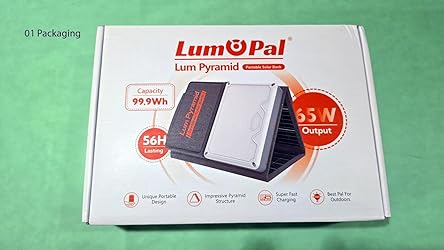
I've been looking at different solar chargers, and I decided on this Lumopal Portable Solar Charger with 24W Foldable Solar Panel, since it could store up to 100Wh, and deliver 65W via USB-C and 22W using USB-A. This would let this Solar Charger work with my MacBook Pro and my Samsung smartphone. I live in Phoenix AZ, and we are blessed/cursed with tons of sun. I drained the system by running the light panel and charging my laptop, and it took roughly 5 and a half hours of daylight (late morning to mid afternoon) to charge up the battery. I like how compact the system is; it folds up slightly larger than a sheet of paper, but has three solar panels that can be laid flat (I did this) or arranged in a triangle. I do some interview videos and being outside, I have plenty of time to setup this up and use it as a secondary power source if I'm away from any outlets or at different outdoor venues. I'm seeing a lot of thought in the design and how practical it is. While I'm not a big camping person, I can see how the system would be great to have; it's lightweight enough and with common-sense planning, you can make sure you have power into the night. The fact that it is solar makes it kinda nice to use! There's essentially no cost to recharge, and it so far has been very consistent in charge times given the amount of sun exposure we get. This Lumopal Portable Solar Charger is a nice investment. While I don't wish for any blackouts, it's nice knowing that a setup like this can handle emergency power if needed.
This is a great panel. It's the smallest panel by far when folded up compared to other panels. This makes it easier to transport and pack for trips without having to worry about larger panels. The downside is that this doesn't have a built-in stand like many do. So if you prioritize portability over performance, this is the panel to get. That said, performance is quite good if you can prop up the panel to face the sun. I was able to measure 110w (which was I believe the max my River 2 can pull) in direct sun up in New England. Some of the specifications in the product description are slightly off. The open circuit voltage (when tested with a multimeter) and according to their user manual is actually 23.5V - 25.9V. Operating voltage is 19.6V - 21.6V. These voltages were too high to use with my Anker 548.

So far, this has been a pretty good little generator, main purpose to power our RV while boondocking. Not too noisy, and starts on the first crank, but... 1. The RV plug (see picture) won't connect as the bottom of the generator faceplate will not allow a standard 90 degree plug to fully insert. So I thought, no problem, pop the cover off and rotate the socket! Well, there is one wire that is 1/2" too short, so you either have to add a different wire, cut the bottom off the generator panel, or build an adapter. Still trying to decide what to do. 2. The CO sensor is WAY too sensitive. Wind was blowing the wrong way and shut it down. There doesn't appear to be a reset switch for it, and unplugging the battery doesn't reset it either. Sitting here for 10 minutes now and still flashing red. Will update with more fun after my next trip. Overall, I would buy it again.

Nice 🔥🤩

I was immediately delighted by the elegant and long-lasting design of this small powerhouse the instant I removed it from its packaging. Because of its folding design, it was exceedingly simple to pack and transport, and it ensured that I would never have to be concerned about the quantity of battery life remaining, regardless of where my travels took me. The two USB outputs were one of the things that instantly struck my attention as being very noteworthy. Through the use of this multifunctional charging solution, I was able to concurrently charge a number of devices, including my smartphone and tablet, as well as my action camera and portable speaker. Instead of waiting nervously for one gadget to charge before going on to the next, you may now move on smoothly.
